

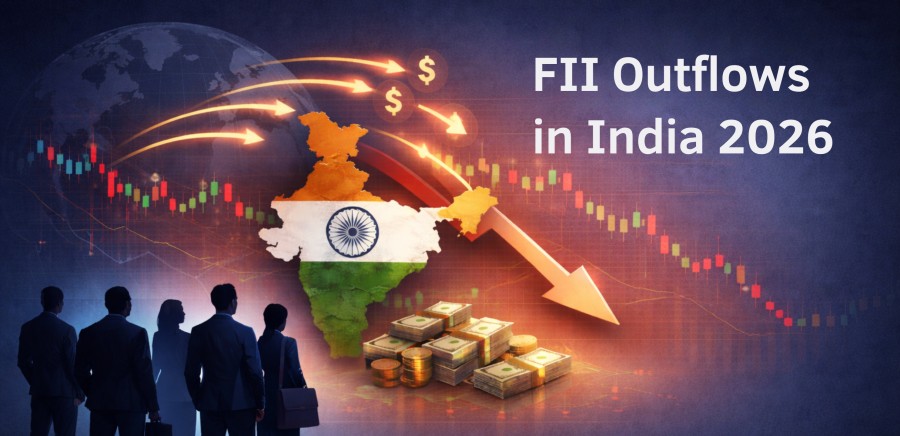
India’s stock market is facing a major challenge in 2026 as Foreign Institutional Investors (FIIs) continue to pull out massive funds. According to recent data, FIIs have withdrawn nearly ₹1.75 lakh crore from Indian equities this year, with ₹43,967 crore outflow in April alone.
This sharp sell-off has raised concerns among investors and analysts, as global factors and upcoming policy decisions—especially the US Federal Reserve’s FOMC meeting—are expected to influence market direction further.
What is FII Exodus and Why It Matters
Foreign Institutional Investors (FIIs) are global investors who invest in stock markets of countries like India. Their investment plays a crucial role in:
- Boosting market liquidity
- Supporting stock prices
- Increasing investor confidence
When FIIs start withdrawing money on a large scale, it creates selling pressure, leading to market volatility and decline.
In 2026, this outflow has reached alarming levels, making it one of the biggest capital exits in recent years.
Key Numbers Behind the 2026 FII Sell-Off
The scale of the current exodus is significant:
- ₹1.75 lakh crore total outflow in 2026
- ₹43,967 crore withdrawn in April alone
- Continuous selling trend for months
This marks a continuation of a long trend, with FIIs remaining net sellers since late 2024.
Such sustained selling has impacted major indices like Sensex and Nifty, causing sharp fluctuations in the market.
Why Are FIIs Pulling Out Money?
1. Global Uncertainty and Geopolitical Tensions
One of the biggest reasons behind the FII exit is global instability. Rising tensions in regions like the Middle East have increased oil prices and inflation concerns, making investors cautious.
2. High US Interest Rates
The US Federal Reserve’s monetary policy plays a major role. Higher interest rates in the US attract global investors, as they can earn better returns in safer assets like US bonds.
This reduces the attractiveness of emerging markets like India.
3. Valuation Concerns in Indian Markets
Experts believe Indian markets are currently expensive compared to other Asian markets. Countries like South Korea and Taiwan are offering better growth opportunities, leading to capital shift.
4. Sectoral Weakness
Key sectors such as IT and banking have shown slower growth, which reduces confidence among foreign investors.
Impact on Indian Stock Market
Market Volatility Increases
Heavy selling by FIIs leads to:
- Falling stock prices
- Increased volatility
- Negative market sentiment
Pressure on Nifty and Sensex
Recent data shows sharp declines in indices due to FII selling pressure. Even strong global cues have not been enough to reverse this trend.
Sector-Specific Impact
Financial stocks, IT companies, and large-cap stocks have been the most affected, as FIIs typically invest heavily in these sectors.
Role of Domestic Investors (DIIs)
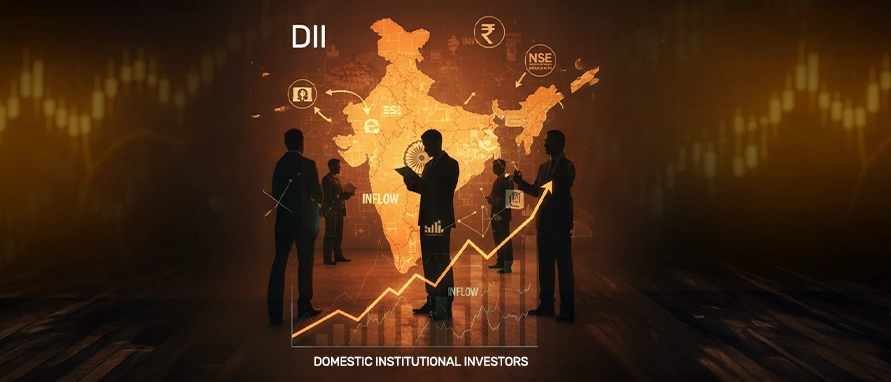
While FIIs are selling, Domestic Institutional Investors (DIIs) have been supporting the market by buying stocks.
This has helped:
- Reduce market crash risk
- Stabilize prices to some extent
- Maintain investor confidence
However, DII support alone may not be enough if FII selling continues at this pace.
FOMC Meeting – The Next Big Trigger
The upcoming US Federal Open Market Committee (FOMC) meeting is being closely watched by investors.
- Decision on interest rates expected
- Signals about future monetary policy
- Impact on global capital flows
Markets believe that this event could be the next major trigger for FII movement.
If the US Fed maintains high interest rates, FII outflows may continue. On the other hand, any sign of rate cuts could bring foreign investors back into emerging markets like India.
Is This Temporary or Long-Term Trend?
There is an ongoing debate among experts:
Short-Term View
Some analysts believe this is a temporary phase driven by global uncertainty and interest rate cycles.
Long-Term View
Others argue that India’s declining weight in global indices and lack of strong sector leadership may keep FII flows weak for longer.
What Should Investors Do Now?
For retail investors, this situation requires caution:
- Avoid panic selling
- Focus on long-term investments
- Diversify portfolio
- Keep an eye on global events
Market volatility can also create buying opportunities for strong fundamentally sound stocks.
The Road Ahead
The massive FII outflow in 2026 highlights how deeply Indian markets are connected to global financial trends. While India remains one of the fastest-growing economies, external factors like US interest rates and geopolitical tensions continue to influence investor behavior.
The upcoming FOMC decision will play a crucial role in determining the next direction of the market. Until then, volatility is likely to remain high.
For investors, the key is to stay informed, patient, and focused on long-term growth rather than short-term fluctuations.